
19 things I've learned
from one year of "unemployment"


It’s officially been one year since I left it all behind.
The salary, the benefits, colleagues, friends, stability, comfort. I left the place I called home for almost four years, uprooting my life to the other side of the world nine timezones away for a chance to create something of my own.
I’ve learned and experienced so much about myself and the world since then. Some days, I can’t sleep with all of the thoughts in my head. Some days, I wish I could go back in time to those simpler days. But I don’t regret the decisions I’ve made, and I wouldn’t trade the life I’ve lived, the people I’ve met, and the knowledge I’ve gained for anything in the world. Though, maybe I would’ve traded it for a $100M Anthropic pay package distributed over five years.
Anyways, here are at least 19 things I’ve come to believe from the past year.
It’s all mindset
Life is now full of high highs and low lows. Through thick and thin, believing in yourself is really the hardest but most important thing. Those who believe they will succeed and win are fundamentally different people than those who think they will lose before the match begins. So believe in yourself. And if you can’t believe in yourself all the time, find people that will. Piece them together if you need to for different parts of your life.
Grit vs stamina
Grit is when you get up when times get tough. I think it’s one of the most important traits in doing great things, but what’s even more difficult is stamina.
Posting on a blog 3-4 times a day, often with little engagement. Working in the void for a long time, maybe like how Mr. Beast made Youtube videos for years without any real traction until he went viral. Stamina is the thing that makes you show up every day, even if you don’t feel like it, even when it feels like no one is paying attention.
Just show up
Humans are strange, emotional creatures. If two people are working with me, and both work the same exact 12hrs/day, but one is sitting next to me every day while the other’s fully remote, I’d give more opportunities to the person on-site with me almost any day. People give chances to those who show up physically. In a world where most jobs can be done remotely, the effort to show up in-person is more important than ever. Show up even when it’s hard, especially when it’s hard. It matters more than we think.
Don’t posture
One of my biggest icks—maybe it’s a residual instinct from my valley days. Posturing is different from confidence or competence. It’s performative, and feels completely hollow. Performative building will probably never go away, but I cannot stand those who talk the talk without the substance to back it up. I think this is called “grifting”? I love this word.
Everyone’s just working on their flywheel
When there’s a fixed pool of money every year from, for example, an annual grant budget for a disease area, there’s naturally going to be a zero-sum mindset. We all spend our careers setting up our flywheel, and want to protect it—our relationships, our sources of income, etc.
Understanding these incentives and what everyone’s flywheels are, and what they want them to become, is the key to getting things done in a positive-sum fashion where everyone can win.
Become infectious, because ideas can’t scale alone
You can conceive an idea alone, but you cannot accomplish it by yourself. You need a team, partners, and funders to work with you. Learning how to attract great talent is a skill that can be learned, but it’s also something that comes from within. People intrinsically have to want to work with you over other people. That sort of infectiousness is very different from the hard skills you need to learn to hire and interview well.
The terminal job in all professions is sales
Fundraising is the most important skill that is lacking in 95%+ of all scientists, especially the brilliant ones. Crafting a compelling narrative around your science is a completely different skill than the one you used to conjure it. If you can train that skill though, you can help direct funding towards great science that deserves it. I think there’s nothing more rewarding than that.
Lastly, fundraising, unlike the science, is transferable. Once you learn it, you can apply it to anything.
Word of mouth over everything
Word of mouth matters more than any LI or X post. These platforms are important mediums to spread your ideas, but your ideas have to be repeatable in-person, by people, to people. There are a few ways to think about this: “meme-able”, “Jaws in Space”, “Uber for x” just to name a few. Creating these vehicles is key to making your ideas spread.
No one cares, no one remembers
People’s attention spans are shorter than ever. People also generally don’t care as much about you as you think. This should empower you to take more risks and put more of your thoughts out there, because everyone will have forgotten your one sentence over the millions of words they’ve read since then. Almost no one really reads all of Owlposting’s pieces, most people just read the title, skim the subheadings, and rate him. It’s just human nature.
Those who do, will understand you
We all just want to be understood. But you can’t be understood if you’re silent. So speak up, say what you believe, because it’s the best and fastest way to attract people you like into your life. For what it’s worth, my life has gotten much richer since writing online.
Zero sum thinking will consume the soul like cancer
Sometimes I realise it’s unavoidable, but I personally really don’t see the value in it at the macro-level. Sure, micro-level negotiations can get nit-picky over hourly rates or contracts over <10% differences. But at the end, the cash is abundant and there’s many routes to find funding. Long-term, I believe this thinking at the macro-level will inevitably eat away at your worldview and change who you are. I try to avoid it where I can.
It only takes one person to really believe in you
But finding that person is really, really hard. These can be friends, colleagues, mentors or someone else. But those people are so rare that the whole point of life can sometimes feel like it’s about picking up those people as you go.
There’s no strategy
The hero’s journey is something you tell, not the path you take. In hindsight, it all makes sense. But until then, it’s going to hurt. “Strategy” feels too unrealistic because it sounds too precise for what it actually is. If I had to describe what philanthropic fundraising feels like, it’s:
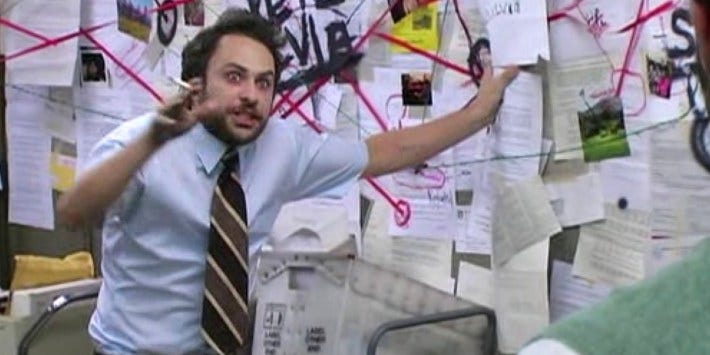
You can be anyone
When you’re meeting someone in-person, in that exact moment, you can be anyone. You can impress, win, lose, empathise, take, or posture. Contrary to popular belief, I think most people also don’t really look you up on the internet. They just don’t have the time or care enough. So that moment matters most, and it’s a superpower. So what if you fumble one funder/person? Brush yourself off and just try again next time.
Say the hard thing, then say it over and over again
Lots of people want to say what you have to say, but they can’t. This could be employees with conflict of interest, professors with grant obligations. What’s more, many ideas are worth being said more than once, twice, even a dozen times. If you believe in it, say it over and over again, until the world really listens. Then say it another time. For every Zoomer who might call you a one trick pony, there will be dozens thanking you for it.
You can’t motivate people with fear/threats
Or rather, I don’t think you should, especially since I think it’s scientifically proven it doesn’t work long term. This is actually something my old manager would say to me, and found this to be true every time. Life is a series of gifts and people believing in you. Don’t try to summon that goodwill with fear or threats. It’s not just bad karma, but it will catch up to you one way or another.
With time, it will become clear those who took risks and who did not
Very few people do great things without taking any risk. It’s like riding an adult rollercoaster. Some people even chase that feeling—I know at least I do. Take big risks, because those risks you thought were massive will eventually feel small in hindsight. If you fail, try again. As long as it doesn’t completely break you, you can keep going.
Your body is your vessel. Respect it.
Life is a great gift, and your body is, to our knowledge, the only way to experience it.
But especially as we’re young, we only think about our bodies when it’s falling apart and screaming for help. Take care of your body. Respect it. I’ve been fortunate to learn this lesson early with an injury and experiencing chronic pain. I’d drop everything, spend thousands of dollars, uproot my life to fix my body and treat it.
There’s also so much more we can experience with our bodies that we often don’t allow ourselves to experience in our day-to-day lives. Outside the routine, we can experience real fear, anger, euphoria, and thrill.
Optimism is a superpower
Optimism is about embracing problems as opportunity, because the problems we face today were the result of solutions from the past. Today’s solutions will inevitably create problems in the future, because science expands our ignorance faster than our knowledge.
Problems are, at some level, a metric of human progress. The gigantic problems we face today require gigantic optimism—optimism that’s infectious, positive-sum, summoned.
When we’re optimistic, we can use it as the power to create the future we want.
I'm so impressed with your determination Alex. Keep up the great work!